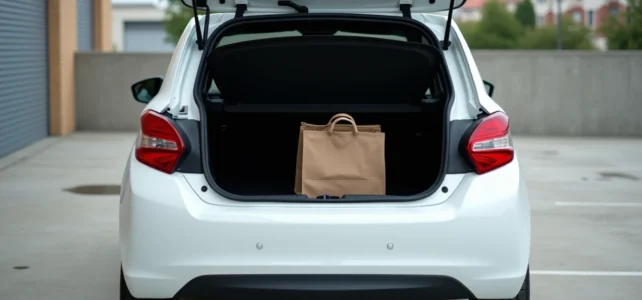
The Peugeot 208 II boasts 309 liters in VDA 210 standard, a figure that places it among the best city cars in segment B, provided that comparable metrics are used. Most competing specifications communicate in VDA 211 or total volume, which skews perception. Taking into account all the nooks and crannies, the 208 II reaches 406 liters, a score that positions this city car at the top of its category.
VDA 210 vs VDA 211: Why the 208’s trunk seems smaller than it is
We regularly observe confusion in online comparisons. The standards VDA 210 and VDA 211 use blocks of different sizes to measure trunk volume. VDA 211, with thinner blocks, fills more corners and produces a higher figure for the same physical space.
You may also like : Everything You Need to Know About Real Estate: Tips, News, and Tricks to Succeed in Your Projects
The 208 II, measured in VDA 210, therefore shows 309 liters. When some manufacturers communicate in VDA 211 without specifying, the apparent gap with the 208 reaches several dozen liters, while the trunks are practically identical in reality. For the trunk capacity of the Peugeot 208, the total usable volume (including nooks) rises to 406 liters, which places this city car at the top of its category.
This method discrepancy explains why some forums deem the 208’s trunk “narrow” compared to certain rivals, while vehicles in the segment hold similar dimensions when measured by the same standard.
Read also : Everything You Need to Know About Resetting Wireless Mice: Instructions and Tips

Trunk volume of the 208 hybrids 2026: What hybridization really changes
The new Hybrid 100, Hybrid 136, and Hybrid 145 e-DCS6 engines raised a legitimate question: do the 48 V battery and the electric motor integrated into the gearbox take up space in the trunk?
For the 2026 hybrid 208 models, recent commercial data indicates 352 liters in base volume and 1,163 liters with the rear seats folded down. This is higher than the 309 liters and 1,118 liters of the previously measured thermal versions. The latest generation MHEV architecture no longer penalizes the trunk: the mild hybrid system is fully housed in the engine compartment and transmission, without encroaching on the loading floor.
We recommend checking the technical specifications of the exact model before purchase. Between a 2020 208 PureTech and a 2026 Hybrid 145, the difference in usable volume is real and favors the recent hybrid version.
Loading threshold and trunk shape: Constraints that liters don’t reveal
A volume in liters tells only part of the story. On the 208 II, the loading threshold is at a relatively low height for the segment, making it easier to slide heavy objects without lifting them. The shape of the trunk is regular, without overly intrusive wheel arches, but the width between the side trims remains constrained by the city car’s dimensions.
- The rear shelf is rigid and removable: removing it frees up a few centimeters in height for loading above the level of the rear window
- The trunk floor has a low position and a high position, the latter creating a flat bottom with the rear seats folded in a 60/40 split
- The underfloor compartment accommodates a inflation kit or, depending on the versions, a space-saver spare wheel that then reduces the depth under the false floor
The 60/40 split rear seat is standard on almost all trims. By folding down the 60% section, there is enough space to slide a long object (skis, curtain rod, flat-pack shelf) while still maintaining a rear passenger seat on the passenger side.
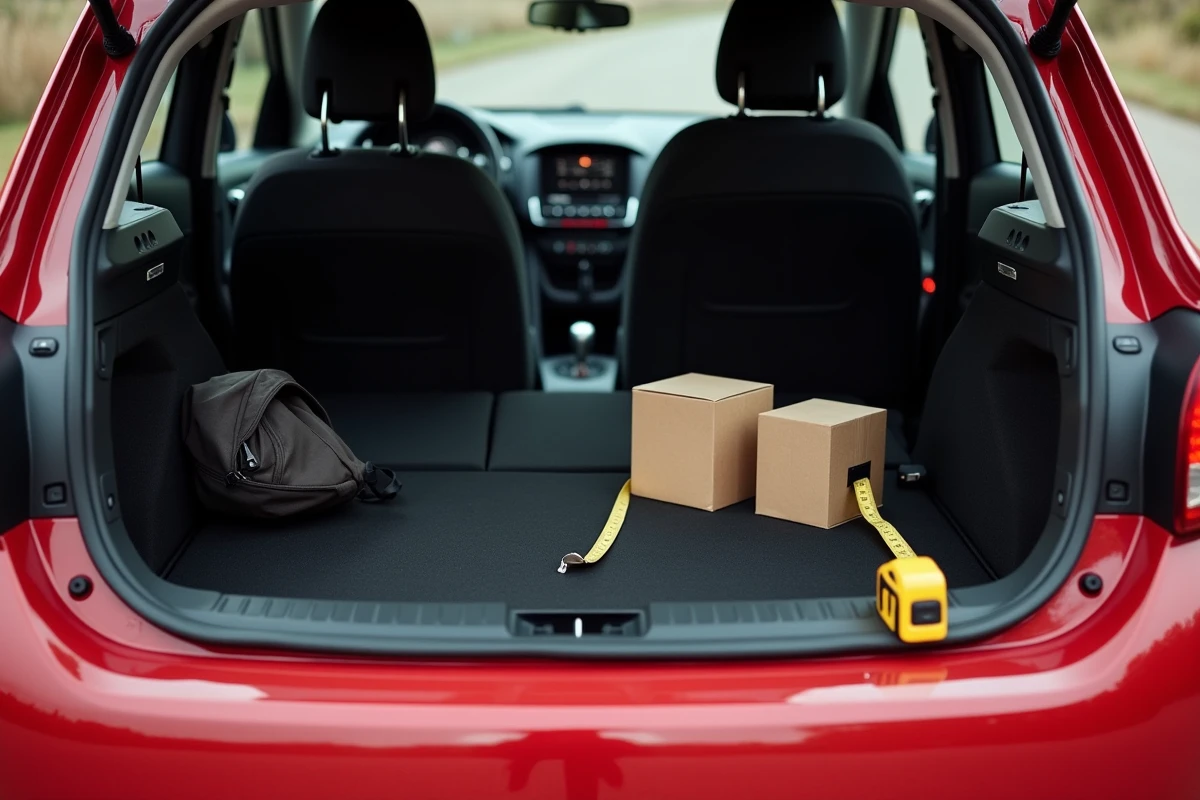
Peugeot 208 trunk storage tips: Utilize every nook
The trunk of the 208 does not come with a retention net or organizer as standard on all trims. A few practical solutions allow for increased convenience without permanent modification.
- A soft trunk organizer with compartments (available as a Peugeot accessory or aftermarket) secures groceries and prevents lateral sliding in turns
- Bag hooks that attach to existing anchor points keep bags upright without tipping over
- A custom trunk tray sized for the 208 II protects the carpet and creates a lip that contains liquids in case of spills
- Lifting the floor to the high position when the rear seats are folded eliminates the step between the trunk and the seat base, allowing for smooth sliding of long loads
The double floor is the most underutilized element of the 208’s trunk. By removing the inflation kit (or storing it in a door pocket), a discreet space is freed up for valuables or charging cables on the e-208.
Allure and GT trims: Storage differences
On higher trims (Allure, GT), the 208 offers more interior storage: a central armrest with a compartment, deeper door pockets, and a wider console tray. These details do not change the volume of the trunk itself, but redistribute small items out of the trunk, freeing up loading space for luggage.
The choice between Active and Allure trim also hinges on these interior layout details. A driver who regularly transports professional equipment will benefit from checking for the presence of the central armrest and adjustable double floor on the targeted version.
The 208 II compensates for its city car size with a well-thought-out trunk architecture and accessible modular solutions. The volume gap with segment rivals disappears as soon as measurement methods are aligned, and the 2026 hybrid versions even add a few extra liters. The key is to choose the right accessories to transform a decent trunk into a truly functional space.