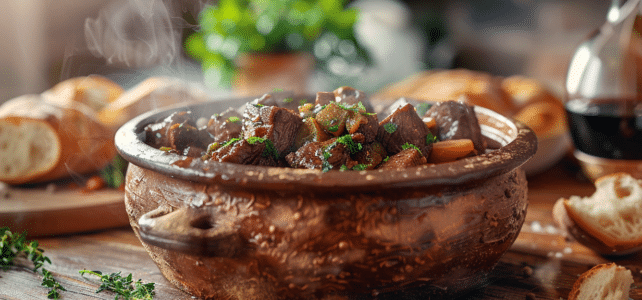
French cuisine is renowned for its finesse, diversity, and elegance. Among its culinary treasures, stews hold a special place. Synonymous with conviviality and tradition, these dishes reflect a know-how passed down from generation to generation. From beef bourguignon to cassoulet, not to mention veal blanquette, these classics warm hearts and bring families together around the table. These recipes, slowly simmered with love, are the essence of French gastronomic heritage, inviting the discovery of authentic flavors and unforgettable moments of sharing.
Stews, a reflection of French terroir
French gastronomy is characterized by a wide array of stews that express the richness of the regions and the diversity of local products. These recipes, combining patience and know-how, are true emblems of the lands from which they originate. Beef bourguignon, for example, is an ode to Burgundy with its emblematic wine, while cassoulet evokes the Southwest and its flavorful beans. It is not just a matter of taste, but of history and identity, each traditional dish carrying the soul of its terroir.
Dishes such as veal blanquette, coq au vin, and pot-au-feu are part of a culinary heritage where the slowness of cooking allows all the subtleties of meats and vegetables to be extracted. They embody suspended time, that moment when aromas intertwine to give birth to deep and complex flavors. Hen in pot and stuffed cabbage complete this culinary picture, offering sensory journeys with each tasting.
It is important to highlight the modernity of these ancient dishes that continue to inspire contemporary chefs. The pork roulade, reimagined, remains an illustration of the adaptability of these recipes, capable of transcending ages without losing their splendor. These dishes, beyond their comforting aspect, are the guardians of a certain philosophy of life: France on its plate, France in its history, France in its culinary future.
From tradition to modernity, the evolution of stews
Stews, once confined to the domestic sphere and prepared in cocottes or fait-touts, now find their place at the forefront of modern cuisine. Chefs like Jean and Roxanne Sévègnes, owners of a Parisian bistro, reinvent beef bourguignon with contemporary touches, while Céline Tafarello, a cassoulet expert, deconstructs this classic to offer a lighter, reimagined version. Éric Tronchon, on the other hand, revisits pot-au-feu by incorporating innovative culinary techniques, thus pushing the boundaries of traditional recipes.
Beyond French borders, the influence of stews extends and mingles with distant cuisines. The Moroccan tajine and Vietnamese phở, perfect examples of this category, establish themselves in the French culinary landscape, demonstrating the ability of saucy dishes to adapt and integrate flavors from elsewhere. These dishes, while preserving the spirit of stewing, invite an openness to the world and a fusion of tradition and exoticism.
Culinary utensils have evolved to accompany this transformation. The cocotte and fait-tout, age-old instruments of stewed cooking, have been adapted to contemporary demands. They now come in modern versions, with more efficient materials and designs suited to new trends. Loïc Bienassis, a specialist in the origins of saucy dishes, emphasizes that the renewal of utensils has played a significant role in the evolution of cooking methods and, consequently, in the rediscovery and preservation of ancestral recipes.