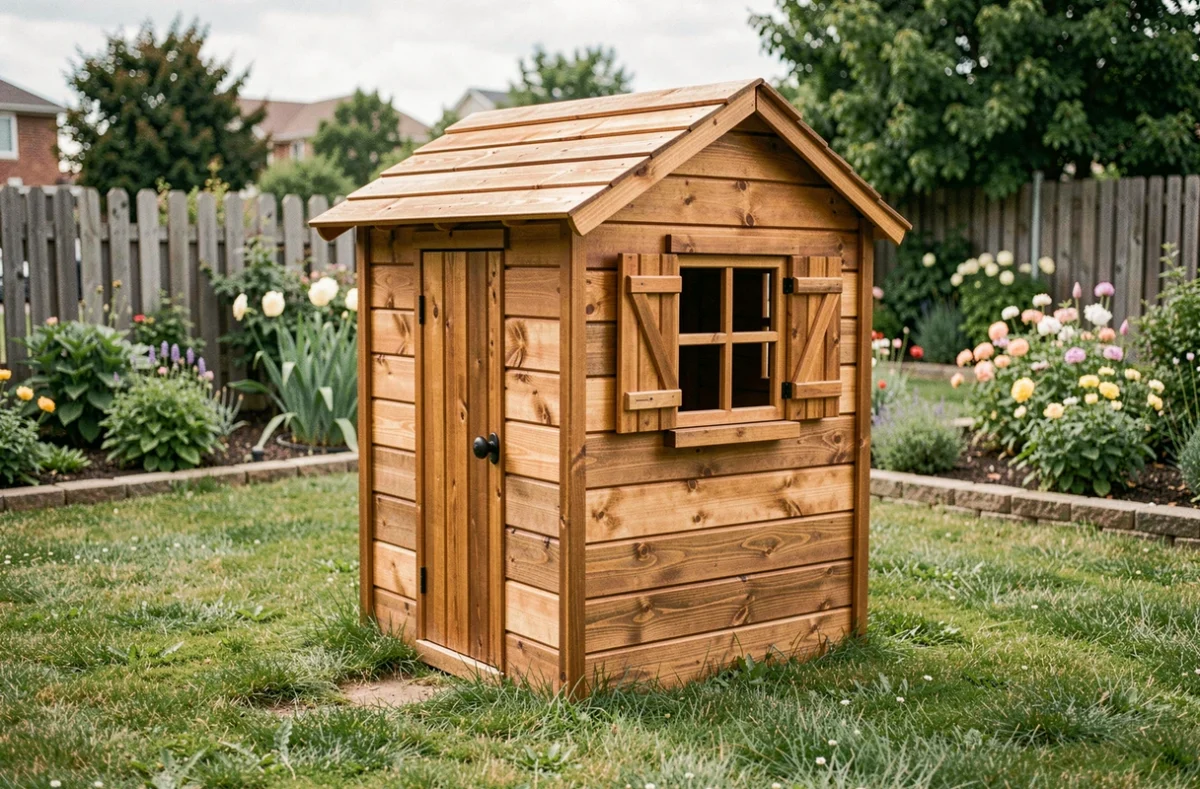
The outdoor games section of Brico Dépôt regularly offers children’s playhouses at competitive prices. Choosing a children’s garden cabin from this store means looking beyond the displayed price: the applicable standard, ground preparation, and material durability weigh as much as aesthetics in the success of the project.
NF EN 71-8 standard and CE marking: what compliance really covers for a children’s cabin
A cabin intended for a family garden is generally subject to the NF EN 71-8 standard, applicable to domestic activity toys. This standard governs mechanical and physical properties, flammability, and the migration of certain substances. It is distinct from the NF EN 1176 series, which is reserved for equipment in collective playgrounds.
The presence of the CE marking on the packaging indicates that the manufacturer declares compliance with European requirements. However, this marking alone does not guarantee a high level of robustness or safety. The EN 71 series covers several aspects, and not all models are tested with the same rigor on each criterion.
Before purchasing a children’s garden cabin at Brico Dépôt, ensure that the product sheet explicitly mentions the EN 71 reference and not just the CE symbol. This precaution helps to eliminate structures sold as decorative or not classified as toys, which escape the controls provided by the European directive on toy safety.
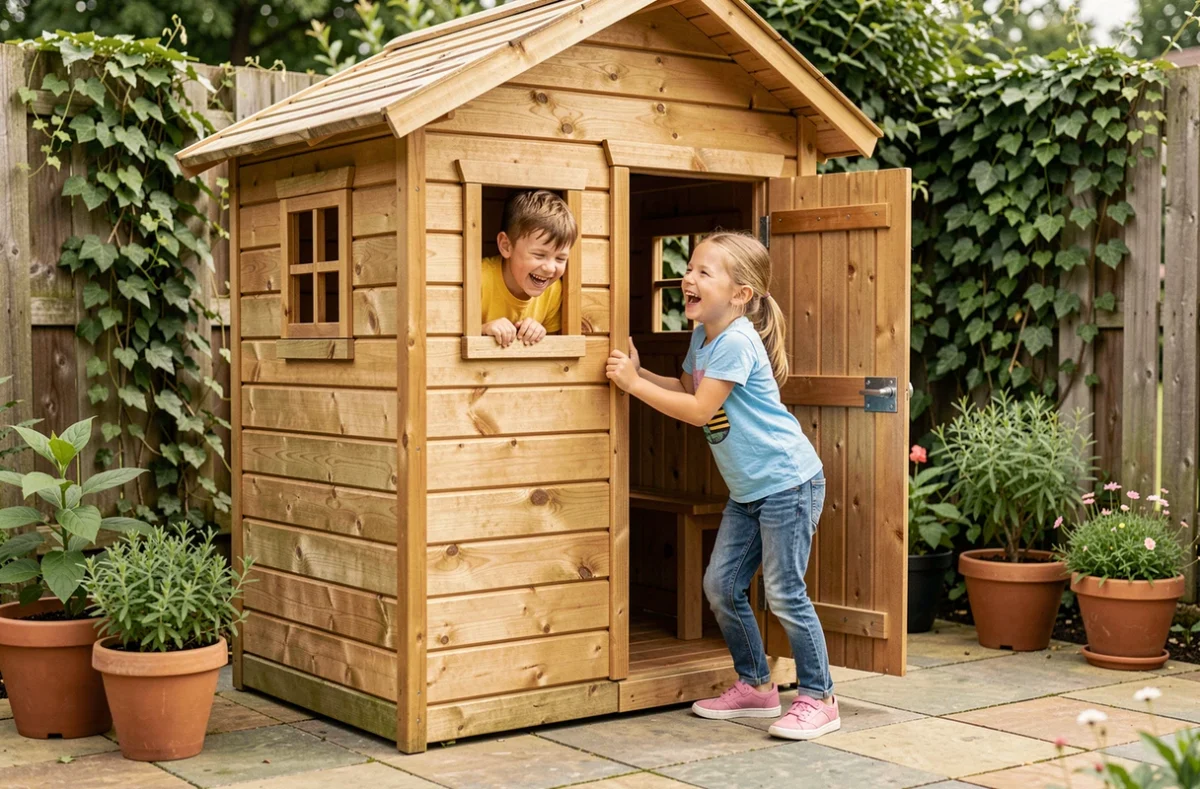
Ground anchoring and free zone: the hidden costs of a children’s garden cabin
Field feedback varies on this point, but one observation often recurs: ground preparation can cost as much as the cabin itself. A cheap model placed on sloped or loose ground is likely to deform within a few months.
Flatness and squareness of the base
The assembly instructions for wooden cabins require a perfectly flat ground. If your terrain has even a slight slope, you will need to plan for concrete blocks, stabilizing slabs, or a frame made of joists. These elements are generally not included in the kit sold in stores.
The squareness of the base determines the stability of the entire structure. A base that is off by a few centimeters is enough to prevent the proper closing of doors and windows, leading to water infiltration into the wood.
Safety zone around the structure
For a model combining a playhouse, raised platform, or slide, the instructions may require a cleared zone around the cabin that is significantly larger than the ground footprint. This safety perimeter reduces the available space in the garden and must be considered before purchase, not after.
- Measure the ground footprint indicated on the product sheet, then add the free zone mentioned in the instructions (often available for download on the store’s website).
- Check for the absence of obstacles in this perimeter: fence, low wall, tree, garden furniture.
- If anchoring by sealing is planned, include the necessary materials (concrete, threaded rods) in your total budget.
Pressure-treated wood, raw wood, or PVC: which material lasts outdoors
At Brico Dépôt, children’s cabins are mainly available in wood (raw or pressure-treated) and in resin or PVC. The choice of material determines both the longevity of the structure and the annual maintenance load.
Pressure-treated wood resists insects and moisture without additional treatment for several years. Untreated raw wood requires the application of a stain or saturator as soon as it is assembled, followed by regular renewal. Neglecting this treatment exposes the structure to rapid graying and mold that weakens the joints.
Models made of PVC or resin only require a wash with a water jet. Their aesthetics are divisive, but their resistance to weather is superior to that of unmaintained wood. However, they do not handle modifications (adding shelves, customization) as well, and their rigidity may decrease under high heat.
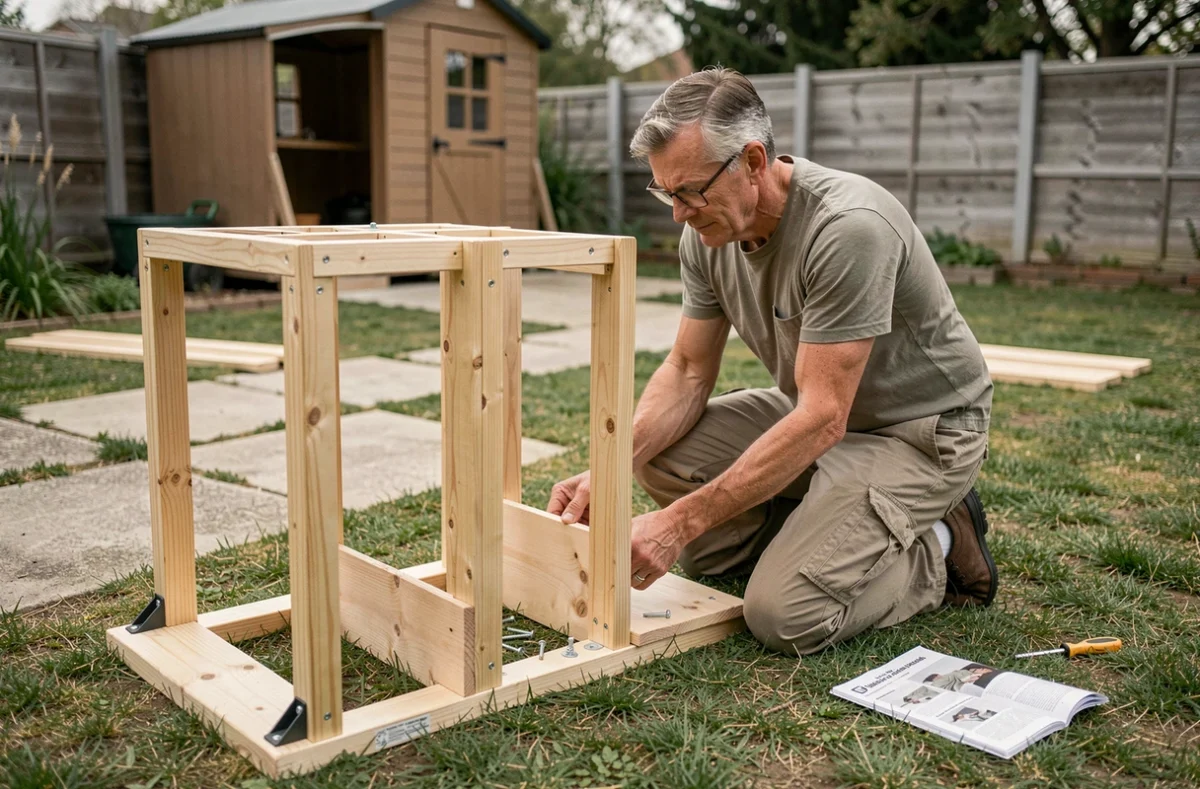
Simple cabin or raised playhouse: adapting the model to age and space
The available data do not allow for a universal age to be set for each type of cabin, as motor maturity varies from child to child. Some practical guidelines help to guide the choice.
- For children under three years old, a single-story playhouse with a wide door and a low threshold limits the risk of falls. PVC models, lightweight and with rounded edges, are particularly suitable for this age group.
- From four or five years old, a raised cabin with a ladder or stairs stimulates motor skills more. Ensure that the platform height remains compatible with the free zone required by the instructions.
- Beyond eight years, the interior dimensions matter as much as the equipment. A cabin that is too small will be abandoned in a few months. Opt for a model with a roof height that allows the child to stand up.
The dimensions mentioned on the product sheet correspond to the external footprint. The usable interior space is always several centimeters less, sometimes more on models with thick solid wood walls.
Checks before purchasing in Brico Dépôt store
The stock of children’s cabins varies according to the seasons and arrivals. Some models are only available online with in-store delivery. Before you go, check the product sheet on the website to find the exact reference, dimensions, and availability.
In-store, open the box if possible to inspect the condition of the panels. Products stored outdoors under a tarp may show signs of moisture. A warped or mold-stained panel will complicate assembly and reduce the lifespan of the structure.
Keep the assembly instructions and proof of purchase: they condition any subsequent claims, especially in case of missing parts or defects found after assembly. The legal warranty of conformity applies, but it assumes that you can demonstrate that the defect existed at delivery.
The low price of a children’s cabin does not reflect the actual cost of the project. Ground, anchoring, wood treatment, and safety accessories add to the bill. Anticipating these items avoids unpleasant surprises and ensures an installation that will last several seasons in the garden.