A candidate who opens the hood for the first time on the day of the practical exam easily loses their bonus point, and sometimes their focus for the rest of the test. The three oral questions asked by the inspector concern simple actions (showing a jar, operating a control), but the lack of preparation turns these tasks into a source of stress.
Reviewing from a structured PDF remains the fastest way to memorize the expected answers, provided you work from a reliable and up-to-date document.
2026 License Verification PDF: How to Spot a Reliable Document
There are dozens of PDF files titled “2026 License Verification Questions” on search engines. The problem is that the 2026 vintage does not necessarily correspond to a new official bank. No recent official publication has announced a replacement for the current question bank.
Some PDFs claim, for example, that five series would have lost their first aid question in 2026. Other recent sources indicate that no questions have been added or removed. This contradiction is not resolved by any accessible regulatory text: this alleged removal is therefore considered unverified.
Before downloading a file, check two things: the upload date and the mention of the source (DSR/BRPCE or Road Safety). A document that cites no institutional reference is likely a reworked copy without any guarantee of compliance. To access a structured revision support around the 2026 License Verification PDF, it is better to prioritize platforms that reproduce the official content without modification.

What Really Changes in the Driving License Exam in 2026
The announced changes for 2026 mainly concern the general theoretical test (ETG), not the three oral questions of the practical test. The code series incorporate more situations with cyclists, electric scooters, and pedestrian priorities.
An organizational change is planned for July 1, 2026: session booking must be done no later than the day before. Regarding practical verifications, the question bank remains the same. The European and national recommendations discussed this year do not yet change the content of the practical exam.
In short, a candidate taking the B license in 2026 reviews the same verification questions as a candidate from 2024. The urgency is not to look for a “new list,” but to master the one that exists.
Express Revision Method for B License Verifications
The questions are divided into three categories for each draw: a technical verification (interior or exterior), a road safety question, and a first aid question.
Work by Actions Rather Than by Numbers
Memorizing the list in order (series 1, series 2, series 3…) gives a false impression of mastery. On the day, you encounter a random number. Grouping questions by type of manipulation speeds up memorization:
- The interior controls (headlight height adjustment, night mirror position, defogging, hazard lights) are all located around the steering wheel or dashboard. Physically locating them in the driving school car takes ten minutes.
- The exterior verifications (windshield washer, oil level, tire wear, reverse lights) require opening the hood or walking around the vehicle. These are practiced in the parking lot, with the engine off.
- The first aid questions follow a constant logic: protect, alert, rescue. Remembering this triptych covers the majority of expected answers (recovery position, calling 15/18/112, area protection).
Realistic Revision Pace
Two twenty-minute sessions are enough to cover the entire bank. The first session is for reading all the answers and identifying unclear points. The second, ideally the next day, consists of being questioned orally by a relative or through an online quiz.
A wrong answer to the verifications is never disqualifying. Each correct answer earns a bonus point, for a maximum of three. Losing these points does not result in failure, but in a tight exam, they can make the difference between a favorable result and an insufficient one.
B License Verifications: Common Traps on Exam Day
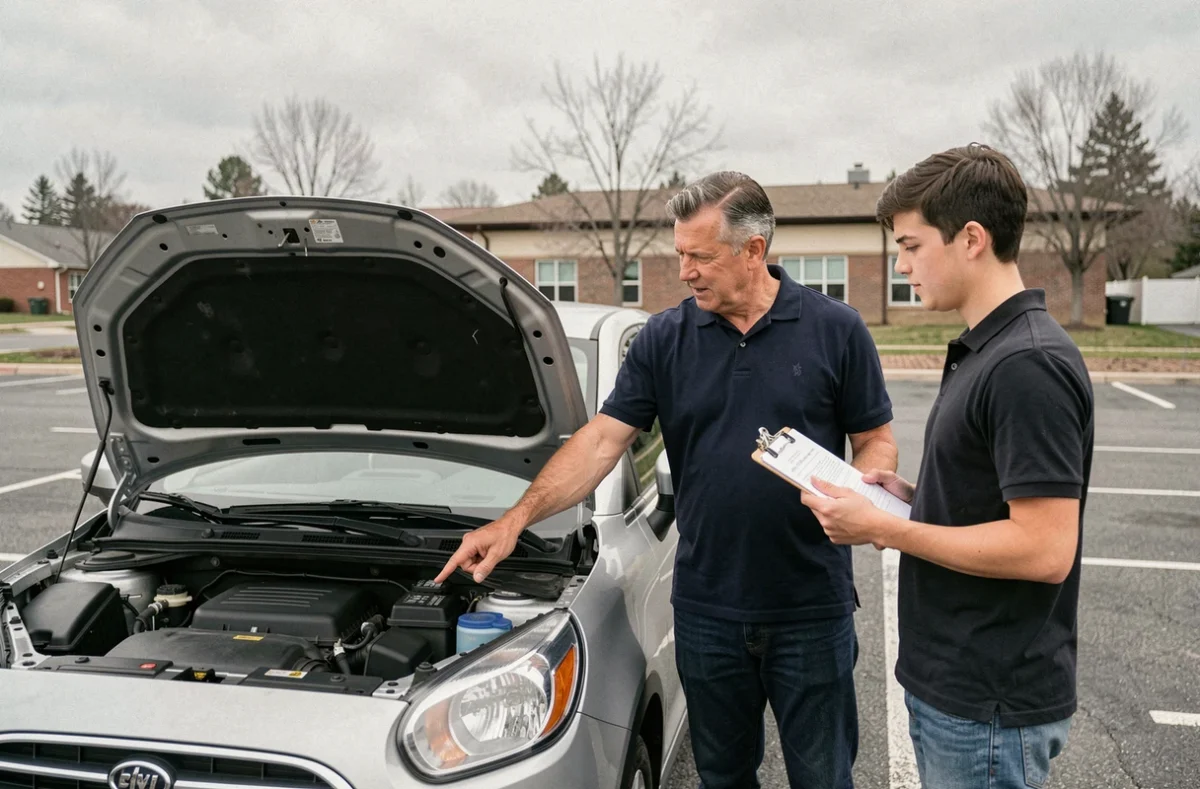
The main trap is not the difficulty of the questions, but the physical manipulation. Showing the windshield washer jar involves opening the hood. On some driving school vehicles, the pull tab is poorly placed or requires a double pull. Asking your instructor to demonstrate the manipulation at least once before the exam prevents a blockage on the day.
Another source of error: confusing the road safety question with the technical verification. The inspector expects a precise answer to each part. Responding “to avoid dazzling other users” when asked to show the adjustment control earns nothing. Feedback varies on this point, but most instructors confirm that the inspector rarely rephrases the question differently if the first answer is off-topic.
The first aid questions pose fewer manipulation problems but require complete formulations. Saying “call for help” without specifying the number (15, 18, or 112) or without mentioning area protection can cost the point.
The official bank contains about a hundred questions divided into series. Investing an hour in targeted revision with a compliant PDF and physical practice on the vehicle largely covers the topic. The rest is played out in driving.